Where This Fits in the Inference Stack
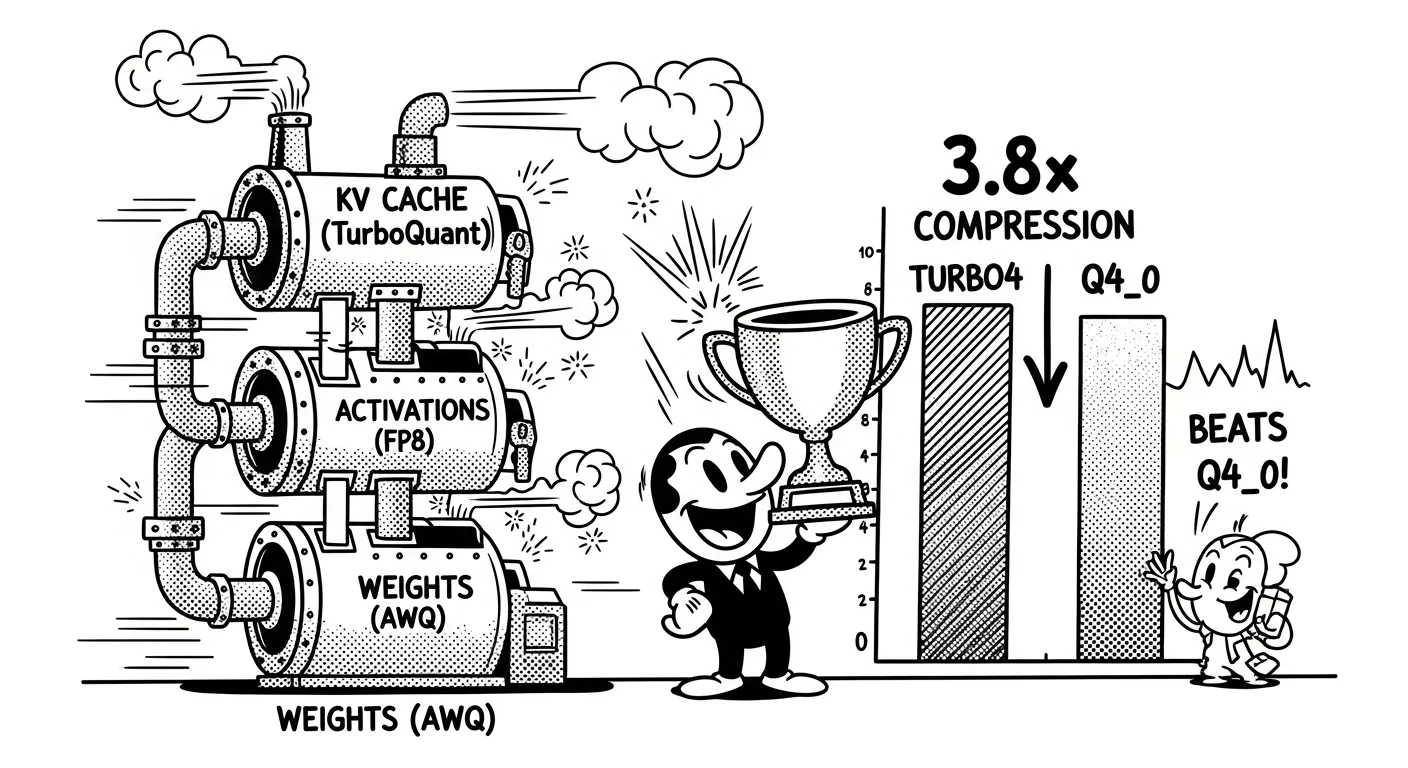
Modern LLM inference is converging toward a layered compression stack where different algorithms handle different memory domains. Each layer is independent and their savings compound.
The Three Layers of Compression
┌─────────────────────────────────────────────────────────┐
│                    LLM INFERENCE STACK                   │
│                                                         │
│  Layer 1: WEIGHT QUANTIZATION                           │
│    What:    Model parameters (static, loaded once)      │
│    Methods: GPTQ, AWQ, GGUF, bitsandbytes               │
│    Typical: 4-bit (4× compression)                      │
│    Status:  Mature. Widely deployed.                    │
│                                                         │
│  Layer 2: ACTIVATION QUANTIZATION                       │
│    What:    Intermediate computation values              │
│    Methods: FP8 (H100/H200/B200), NVFP4 (Blackwell)    │
│    Typical: 8-bit or 4-bit (2-4× throughput gain)       │
│    Status:  Hardware-native on latest GPUs.             │
│                                                         │
│  Layer 3: KV CACHE QUANTIZATION     ← TurboQuant       │
│    What:    Cached attention state (dynamic, grows)     │
│    Methods: FP8 (free, 2×), TurboQuant, KIVI, PolarQ   │
│    Typical: 3-4 bits (4-5× compression over FP16)       │
│    Status:  FP8 deployed; TurboQuant: community live.   │
│                                                         │
│  Each layer compresses a different memory pool.         │
│  The savings are additive, not multiplicative —         │
│  but together they dramatically shrink total footprint. │
└─────────────────────────────────────────────────────────┘
These layers are complementary, not competing. You can quantize weights with AWQ, activations with FP8, AND the KV cache with TurboQuant. Each compounds the other’s savings.
Why KV Cache Was the Last Frontier
Weights:       Static     + Offline OK     + Large    → Solved first
Activations:   Ephemeral  + Hardware-native + Medium   → Solved by hardware
KV Cache:      Dynamic    + Must be online  + Largest  → FP8 solved 2×; TurboQuant solves 4-5×
Quality vs. Compression: The Full Comparison
The honest comparison includes FP8 KV — the hardware-native baseline that ships today — alongside TurboQuant. Measured on wikitext-2, Llama family, M5 Max 128GB. Lower perplexity delta is better.
| Format | Bits/val | Compression | PPL delta vs FP16 | Overhead |
|---|---|---|---|---|
| fp16 (baseline) | 16.0 | 1.0× | 0% | none |
| fp8 KV | 8.0 | 2.0× | ~0% | zero — hardware native |
| q8_0 | 8.5 | 1.9× | +0.16% | software |
| turbo4 | 4.125 | 3.9× | +0.23% | rotation + table lookup |
| q4_0 | 4.5 | 3.6× | +0.52% | software |
| turbo3 | 3.125 | 5.1× | +1.06% | rotation + table lookup |
| turbo2 | 2.125 | 7.5× | +6.48% | rotation + table lookup |
Reading this table honestly:
- FP8 KV is the right first step. It is free on H100/H200/B200, already deployed, and quality-neutral. Use it if 2× compression is sufficient.
- TurboQuant picks up where FP8 stops. Going from 8-bit to 4-bit adds ~0.23% perplexity for another ~2× compression. This is the tradeoff you’re evaluating when choosing TurboQuant.
- turbo4 beats q4_0 at lower effective bit-width, confirming the rotation’s value beyond simple rounding.
What Changes When KV Cache Is 4× Smaller (vs FP16)
Memory:
  └── Same GPU serves 4× more concurrent users  (vs FP16; 2× more vs FP8)
  └── Same GPU supports 4× longer context
  └── Models that needed 2 GPUs now fit on 1

Speed:
  └── 4× less data read from HBM per generation step (vs FP16)
  └── Memory-bound generation becomes faster
  └── Attention kernel speedup of 3-5× measured in microbenchmarks on H100
      (attention is ~25% of decode; end-to-end improvement is proportionally smaller)

Cost:
  └── 4× fewer GPUs for the same workload (vs FP16)
  └── Cloud inference cost per token drops significantly

Capability:
  └── 128K context becomes practical on consumer hardware
  └── 104B model at 128K context fits on a single MacBook (M5 Max)
  └── Long-document processing (books, codebases) becomes routine
Decode Throughput vs. Time to First Token
TurboQuant’s benefits are concentrated in the decode phase — the right framing depends on context length.
For short to medium inputs (<32K tokens):
- Prefill is compute-bound: GPUs run matrix multiplications at near-peak utilization. TurboQuant has minimal impact on TTFT here.
- Decode is memory-bandwidth-bound: for each new token, the entire KV cache must be read from HBM. TurboQuant directly cuts this per-step cost.
For long inputs (>64K tokens):
- Prefill attention becomes memory-bandwidth bound for its attention layers — same regime FlashAttention was designed for. At these context lengths, TurboQuant also reduces prefill HBM traffic and TTFT improves, typically 20–40% at 128K+ context.
Context < 32K:   TurboQuant → decode throughput ↑, TTFT unchanged
Context > 64K:   TurboQuant → decode throughput ↑↑, TTFT also improves (~20-40%)
Production Deployment: Tensor Parallelism
At serving scale, models run across multiple GPUs using tensor parallelism (TP). Each GPU holds a shard of the attention weight matrices and a corresponding slice of the KV cache — at TP=8, each GPU stores 1/8 of the total KV vectors.
TurboQuant must be applied per-shard. Scale factors are local to each shard and don’t require cross-GPU communication. The per-block independence makes this naturally embarrassingly parallel.
Correct: quantize the local KV shard on the owning GPU before writing to HBM
Wrong:   quantize globally then shard → scale factors span GPU boundaries
Existing community implementations handle single-GPU cases. Multi-GPU serving stacks (vLLM, TGI) need explicit TP-aware integration.
TensorRT-LLM: Why Integration Is a Kernel Problem
TensorRT-LLM is listed as “not yet integrated” — not because of resource priorities, but because of kernel architecture. TensorRT-LLM uses fused attention kernels (paged attention, chunked attention, flash-decoding variants) that handle KV reads and dot products inside a single CUDA kernel, without materializing intermediate values.
To support TurboQuant, dequantization must happen inside this kernel — in registers, while K/V tiles are loaded from HBM — not as a separate pre-processing pass. This requires modifying the inner loop of every fused attention kernel variant separately. It is substantial kernel engineering work, not a library wrapper.
Standard fused kernel:  K/V read from HBM (FP16) → attention scores
TurboQuant-fused:       K/V read from HBM (INT4) → dequantize in registers → attention scores

Required change: modify tile-load + compute path of every kernel variant
Scope: chunked-attention, paged-attention, flash-decoding — separately
When TensorRT-LLM integration arrives, it will be kernel-level and will likely be faster than the current community implementations that apply rotation and quantization as separate passes.
Blackwell FP4: The Natural Convergence Point
Blackwell (B200, B100) introduces native NVFP4 tensor core instructions — hardware-accelerated 4-bit floating-point arithmetic. For activation quantization, this is already being used. For KV cache, it represents a future convergence path.
TurboQuant currently uses INT4 integer codebook indices (table lookup dequantization). NVFP4 uses E2M1 floating-point format (hardware-accelerated). These are different representations. But the direction is clear:
Today:
  TurboQuant INT4 + custom CUDA kernel → ~4× KV compression, software overhead

Future (Blackwell-native path):
  TurboQuant centroids mapped to NVFP4 values → hardware-accelerated dequant
  → Same ~4× KV compression, near-zero overhead on B200+
Whether TurboQuant’s Lloyd-Max centroids map cleanly to NVFP4’s E2M1 values (or require retraining with FP4-aware codebooks) is an open engineering question. The algorithmic groundwork is done. The hardware is available. This is the most likely path to zero-overhead 4-bit KV compression on Blackwell.
Disaggregated Serving — Where TurboQuant Has Untapped Leverage
Disaggregated prefill/decode separates prefill nodes from decode nodes, with KV cache transferred over the network. At 128K context with a 70B model, uncompressed KV exceeds 50 GB per request.
Without TurboQuant:  ~50 GB over InfiniBand (200 Gb/s) = ~2 seconds per request
With TurboQuant:     ~11 GB = ~0.45 seconds per request

NVSwitch (NVL72):    14.4 TB/s fabric — transfer time is <1 ms either way
The benefit is largest for InfiniBand-connected disaggregated deployments (the common cloud architecture), not for NVL72 rack-scale systems where NVSwitch bandwidth makes KV transfer negligible. Know your interconnect.
The Production Recipe: W4A8KV4
The current state-of-the-art for H100/H200 inference combines three compression layers:
W4A8KV4 recipe:
  W4:  4-bit weight quantization (GPTQ or AWQ)
       → 4× weight memory reduction, faster weight loads
  A8:  FP8 activation quantization (hardware-native on H100+)
       → 2× compute throughput improvement at near-zero quality cost
  KV4: 4-bit KV cache (FP8 for free 2×; TurboQuant for the next 2×)
       → 4× KV memory and bandwidth reduction

Combined effect on Llama 3.1 70B serving:
  Weights:   140 GB → 35 GB    (W4)
  KV cache:  16 GB/user → 4 GB/user @ 128K context  (KV4)
  Throughput: A8 adds ~1.8× compute ops/sec on H100

System result: ~4× more concurrent users per GPU, ~2× faster decode, 128K context practical
If you are building a production inference stack today, this is the three-line config to evaluate first. FP8 activations require no application changes on H100. W4 via GPTQ/AWQ is widely available for major model families. KV4 via TurboQuant requires the turboquant+ library or a patched llama.cpp.
Compatibility Summary
| Technology | Compatible with TurboQuant? | Notes |
|---|---|---|
| PagedAttention (vLLM) | ✅ Yes | Orthogonal — manages allocation, not size |
| FlashAttention | ✅ Yes | Orthogonal — speeds prefill compute |
| FP8 KV cache | ✅ Complementary | FP8 gives 2× free; TurboQuant gives the next 2× |
| Prefix caching | ✅ Yes | Rotation is deterministic per model load |
| Speculative decoding | ✅ Yes | Acceptance rates unaffected at 3+ bits |
| Continuous batching | ✅ Yes | Smaller KV raises the memory watermark |
| GQA / MQA models | ✅ Yes | Compresses the already-reduced KV heads |
| Disaggregated serving | ✅ Yes | Cuts InfiniBand KV transfer; less impact on NVSwitch |
| Tensor parallelism | ✅ Yes | Per-shard; no cross-GPU coordination needed |
| Blackwell NVFP4 path | 🔬 Research | INT4 → FP4 format alignment is open question |
| Pure SSM models (Mamba) | ❌ N/A | No KV cache to compress |
| TensorRT-LLM | ⏳ Kernel work | Requires fused attention kernel modification |