The Two-Stage Fix — QJL on the Residual
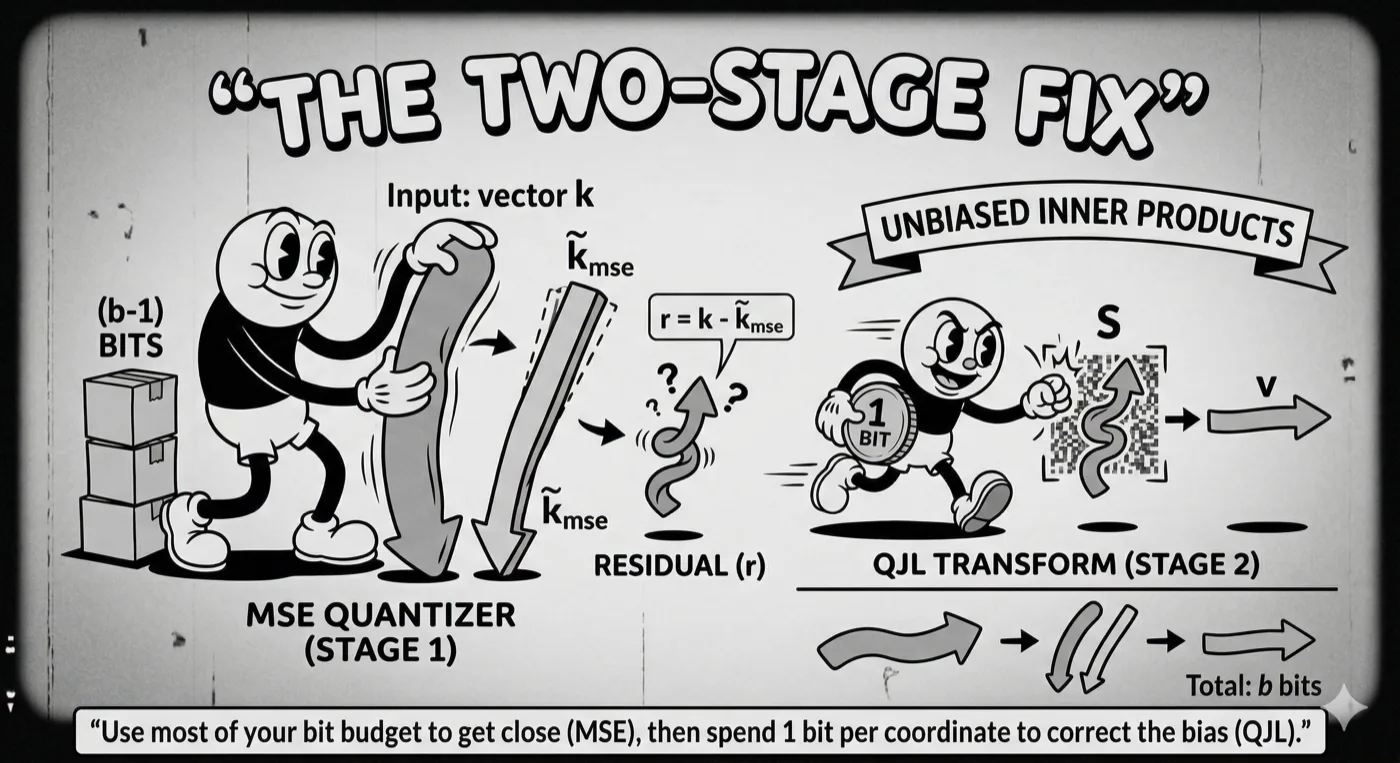
Use most of your bit budget to get close (MSE quantizer), then spend 1 bit per coordinate to correct the bias on whatever error remains.
Stage 1: Get Close with MSE Quantizer
For a target bit-width of $b$, run the MSE quantizer with (b-1) bits instead of $b$:
Input: vector k (unit norm, d-dimensional)

Stage 1: TurboQuant_mse with (b-1) bits
  → Rotate: y = Π · k
  → Quantize each coordinate to (b-1) bits
  → Dequantize to get reconstruction k̃_mse

k̃_mse is close to k, but biased for inner products.
The remaining 1 bit per coordinate is saved for Stage 2.
The Residual: What Stage 1 Got Wrong
The residual is the error left over after Stage 1:
$$r = k - \tilde{k}_{\text{mse}}$$
Since Stage 1 was a good MSE quantizer, the residual is small. For $b = 4$ (Stage 1 uses 3 bits): $|r| \approx 0.17$ – only ~17% of the original vector’s energy.
The inner product error from Stage 1 comes entirely from the residual:
$$\langle q, k \rangle - \langle q, \tilde{k}_{\text{mse}} \rangle = \langle q, r \rangle$$
The problem reduces to: estimate the inner product with a small residual vector, using just 1 bit per coordinate.
Stage 2: QJL — 1-Bit Unbiased Inner Products
The Quantized Johnson-Lindenstrauss (QJL) transform produces a 1-bit-per-coordinate sketch that gives unbiased inner product estimates:
Input: residual vector r (d-dimensional)

Step 1: Multiply by a random Gaussian matrix S (d × d)
        z = S · r

Step 2: Take the sign of each entry
        qjl = sign(z)    → d values, each ±1 → 1 bit per coordinate

Step 3: Store qjl and ||r|| (the residual's norm)
The intuition: if $r$ and $q$ point in similar directions, most random projections of $r$ will have the same sign as the corresponding projections of $q$. The fraction of sign agreements is a noisy but unbiased estimate of their alignment.
QJL trades precision for unbiasedness. Each bit carries very little information, but what it carries is correct on average.
Why the Combination Is Unbiased
E[<q, k̃>] = E[<q, k̃_mse + k̃_qjl>]
           = E[<q, k̃_mse>] + E[<q, k̃_qjl>]
           = E[<q, k̃_mse>] + <q, r>           (QJL is unbiased)
           = E[<q, k̃_mse>] + <q, k - k̃_mse>
           = E[<q, k̃_mse>] + <q, k> - E[<q, k̃_mse>]
           = <q, k>  ✓
The bias from Stage 1 is exactly cancelled by QJL’s unbiased estimate of the residual’s inner product.
It doesn’t matter that Stage 1 is biased. It only matters that Stage 1 makes the residual small (low MSE), and Stage 2 handles the residual without bias.
Why Not Just Use QJL Alone?
Because QJL has variance proportional to the input’s squared norm:
Variance with Stage 1:    (π/2d) × 0.03 × ||q||²   (residual is small)
Variance without Stage 1: (π/2d) × 1.0 × ||q||²   (full vector)
Without Stage 1, QJL’s variance is 33x higher (for 3-bit target). The residual’s small norm is what makes QJL’s variance acceptable.
Storage Requirements
TurboQuant_prod at b bits per coordinate:

  Stage 1 component:   (b-1) bits per coordinate
  Stage 2 component:   1 bit per coordinate + 1 scalar (||r||)

  Total per vector: b bits per coordinate + 1 scalar
  Overhead from scalar ||r||: 16 bits / 128 coordinates = 0.125 bits per coordinate

  Effective cost: b + 0.125 bits per coordinate ≈ b bits  (overhead is small)
The Practical Catch — When QJL Backfires
In the controlled experiments above, QJL clearly outperforms the MSE-only approach. But community implementations across llama.cpp, vLLM, and MLX revealed a surprising finding for production LLM inference:
At 3+ bits, skipping the QJL stage consistently yields better perplexity.
The culprit is softmax amplification. At 3-bit precision, the MSE bias has already shrunk to ~3% of the inner product. But QJL’s residual estimation introduces variance that, when exponentiated by softmax, creates larger fluctuations than the original bias would have. The bias is small and systematic (tolerable); the QJL variance is unpredictable (harmful).
Empirical recommendation from turboquant+ community:

  b ≤ 2 bits:  Use two-stage TurboQuant_prod
               → Bias is 20-36%, QJL correction is essential
               → Variance is less harmful at this bit-width

  b ≥ 3 bits:  Use TurboQuant_mse (MSE stage only)
               → Bias has shrunk to ~3%, acceptable for softmax
               → Skipping QJL eliminates its variance cost
The theoretical optimum and the practical optimum diverge at 3+ bits. This doesn’t invalidate the theory — it reveals that LLM attention is a stricter environment than embedding search, where the full two-stage approach remains the right choice.
This finding is one of the most important things the paper doesn’t tell you. Section 15 (Finding 2) covers it in detail, including the extreme case where QJL causes a 300% perplexity increase at 3-bit on GPT-2. The takeaway: implement the rotation and MSE stage carefully; treat QJL as optional insurance for 2-bit or below.
When Does QJL Actually Help?
The two-stage approach is theoretically optimal for the problem it is designed for: unbiased inner product estimation in embedding search, where you want the expected result to be correct across many queries and where the output is compared by magnitude rather than piped through an exponential function.
For LLM attention, the situation is different in one critical way: softmax amplifies variance. The softmax function is $e^{x_i} / sum_j e^{x_j}$ — an exponential. If QJL’s 1-bit sketch adds high-variance noise to each attention score, softmax does not average it away; it exponentiates it. A small positive noise spike on token A gives A an exponentially larger attention weight, potentially routing attention to the wrong token even though the bias is zero.
Bias vs variance in the attention context:

  MSE quantizer (b-bit):  small bias + low variance → softmax stable
  QJL sketch (1-bit):     zero bias  + high variance → softmax amplifies noise

  At b=1-2 bits:  QJL's unbiasedness wins — the MSE quantizer's bias is large enough
                  to consistently misroute attention; QJL's variance is comparatively benign
  At b≥3 bits:    MSE quantizer's bias is ~3% and shrinks fast; QJL's variance does not.
                  The variance penalty from softmax amplification exceeds the bias correction benefit.
This is why Section 15’s community recommendation is: use QJL only below 3 bits per coordinate. Above that, the plain MSE quantizer — TurboQuant_mse — produces better practical results on LLM attention, even though TurboQuant_prod is theoretically unbiased.
For embedding similarity search (nearest-neighbor retrieval, Section 14), softmax is not involved. QJL wins at all bit-widths there, which matches the paper’s primary validation setting (DBpedia retrieval, Section 12).
The right tool depends on what comes after the inner product. Embedding search: use QJL. LLM attention at ≥3 bits: use MSE-only. LLM attention at 1-2 bits: the theory says QJL should help, and the community agrees.