The Bias Problem — When Minimizing MSE Isn't Enough
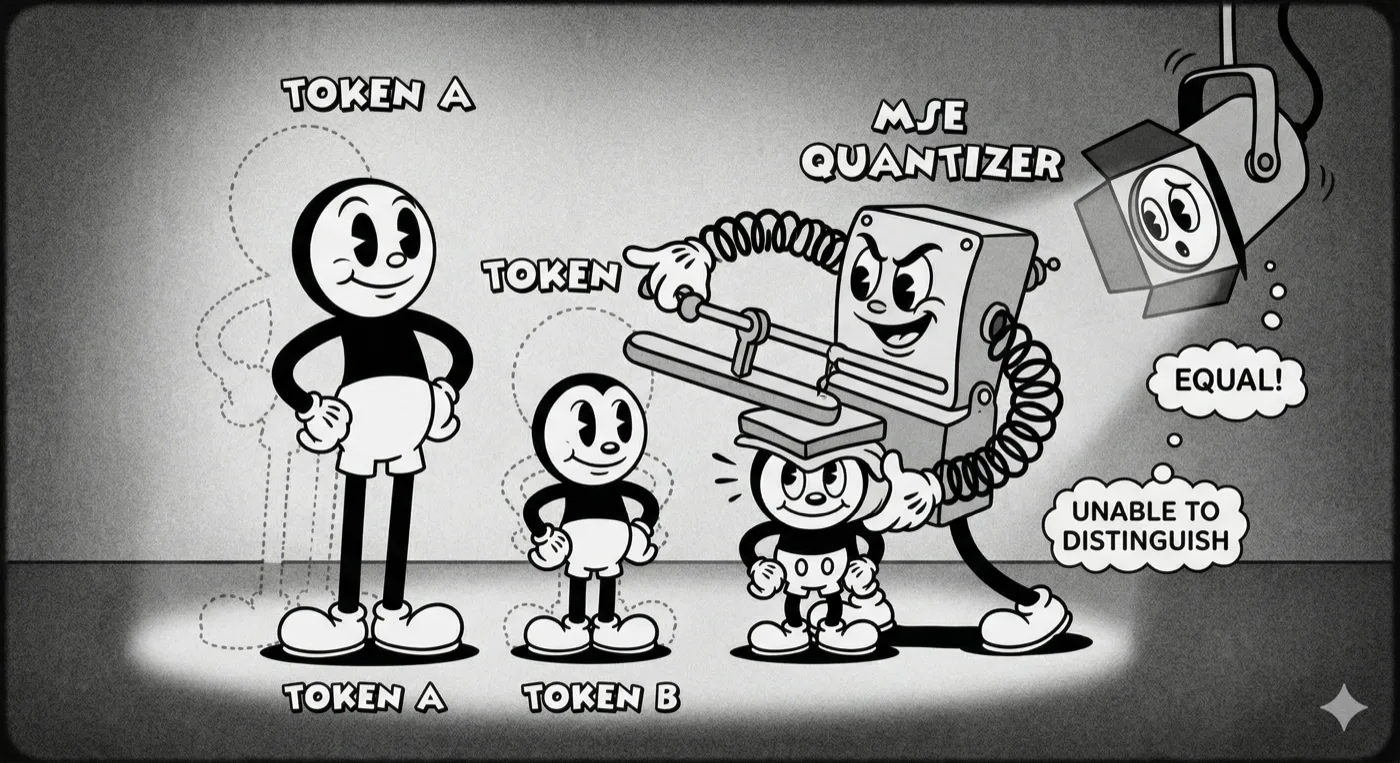
We just showed that TurboQuant’s MSE quantizer is near-optimal – within 2.7x of the best possible reconstruction. But there’s a subtle, critical flaw: the MSE-optimal quantizer is biased for inner products.
What “Biased” Means
The quantizer is randomized – the rotation matrix is random, so the quantized output is a random variable. When the inner product estimator is “biased,” it means:
$$E[\langle q, \tilde{k} \rangle] \neq \langle q, k \rangle$$
The average estimated inner product is NOT equal to the true inner product. This isn’t random noise that averages out – it’s a systematic error in one direction.
Bias is a systematic error that doesn’t average away. No matter how many samples you take, the average is still wrong.
Why MSE Quantizers Shrink Vectors
At 1 bit with a Gaussian distribution $N(0, 1/d)$ for $d = 128$, the optimal Lloyd-Max codebook has two centroids at $\pm\sqrt{2/(\pi d)} \approx \pm 0.071$.
The quantizer takes the sign of each rotated coordinate, then replaces it with $\pm 0.071$. What happens to the vector’s length?
Original rotated vector y:  each coordinate ~ N(0, 1/d)
  → Expected squared length: ||y||² = d × (1/d) = 1    (unit vector)

Quantized vector:  each coordinate = ±0.071  (for d=128)
  → Squared length: ||ỹ||² = d × (2/(π·d)) = 2/π ≈ 0.637

  → ||ỹ|| = √(2/π) ≈ 0.798
The reconstructed vector has length 0.798 instead of 1.0. It’s been shrunk by a factor of 2/π ≈ 0.637. This shrinkage factor is a property of the 1-bit Lloyd-Max quantizer on a Gaussian — it does not depend on d.
True inner product:        <q, k> = 0.50
Expected quantized IP:     E[<q, k~>] ≈ (2/π) × <q, k> = 0.637 × 0.50 = 0.318

Bias:  0.318 vs 0.50 → 36% underestimate
At higher bit-widths, more centroids better approximate the true distribution, and the shrinkage factor decreases. The bias factors below are derived analytically from Lloyd-Max quantizer theory for Gaussian inputs and confirmed by community measurements (within ±0.5% across tested models):
| Bit-width | Bias factor | Inner product preserved |
|---|---|---|
| 1 | 2/π ≈ 0.637 | ~64% |
| 2 | ~0.850 | ~85% |
| 3 | ~0.970 | ~97% |
| 4 | ~0.993 | ~99.3% |
The 3-bit figure (~97%) is the theoretical justification for the practical recommendation in Section 15 to skip QJL bias correction at ≥3 bits: a 3% systematic underestimate is small enough that softmax tolerates it without meaningful quality loss.
Why Uniform Bias Isn’t the Problem
You might think: “If every inner product is scaled by the same factor (e.g., 0.637), then softmax will normalize things out – the relative ranking of attention scores is preserved.”
This is partially true for uniform bias (same scale factor applied to all scores). But the bias is not uniform:
Token A with true inner product 0.80  →  quantized: E[ĨP] = 0.637 × 0.80 = 0.510
Token B with true inner product 0.20  →  quantized: E[ĨP] = 0.637 × 0.20 = 0.127
Token C with true inner product 0.00  →  quantized: E[ĨP] = 0.637 × 0.00 = 0.000
In softmax, the gaps between scores matter more than the absolute values. Softmax of [0.80, 0.20, 0.00] vs softmax of [0.51, 0.13, 0.00] gives different distributions – A gets a larger share in the first case.
More importantly, the effective bias scale factor is not the same for every key vector. It is proportional to the ratio of the quantized vector’s norm to the true norm — which varies across layers and heads. This connects directly to Finding 1 in Section 15: community measurements found that Key vectors have 10–100× larger norms than Value vectors in many models (Qwen, Phi). Because quantization error scales with $|v|^2$, and the bias shrinkage factor depends on the codebook relative to the vector’s actual magnitude, heads with large-norm Keys experience systematically larger absolute bias than heads with small-norm Keys.
In other words: the non-uniform bias is not random — it correlates with model architecture. Layers with larger Key magnitudes have larger absolute bias, which distorts attention more. This is why protecting boundary layers (Section 15, Finding 1, point 3) recovers disproportionate quality: the first and last transformer layers often have the most extreme K/V norm ratios.
The bias is not just systematic — it is structured, correlated with which layers and heads have the largest Key magnitudes.
The Solution: An Unbiased Estimator
We need a quantization scheme where:
$$E[\langle q, \tilde{k} \rangle] = \langle q, k \rangle$$
The expected quantized inner product equals the true inner product. Exactly.
This requires a fundamentally different approach – not just better centroids, but a different kind of quantizer. Section 11 introduces the Quantized Johnson-Lindenstrauss (QJL) transform, which achieves unbiased estimation by design.
A Note Before Moving Forward
The two-stage solution (MSE quantizer + QJL bias correction) is elegant and theoretically sound. In controlled experiments on embedding vectors, it outperforms the MSE-only approach at low bit-widths. Sections 11–13 follow this theory to its conclusion.
Section 11 introduces the specific bias-correction mechanism. After reading it, the practical tradeoffs in Section 15 will make sense: the theory is correct, but real-world deployment on LLM attention surfaces a tension between bias and variance that the theoretical analysis does not fully capture.
The theory in Sections 11–13 is correct. Section 15 explains where it diverges from practice — and why.