From Scalar to Vector Quantization — The Independence Question
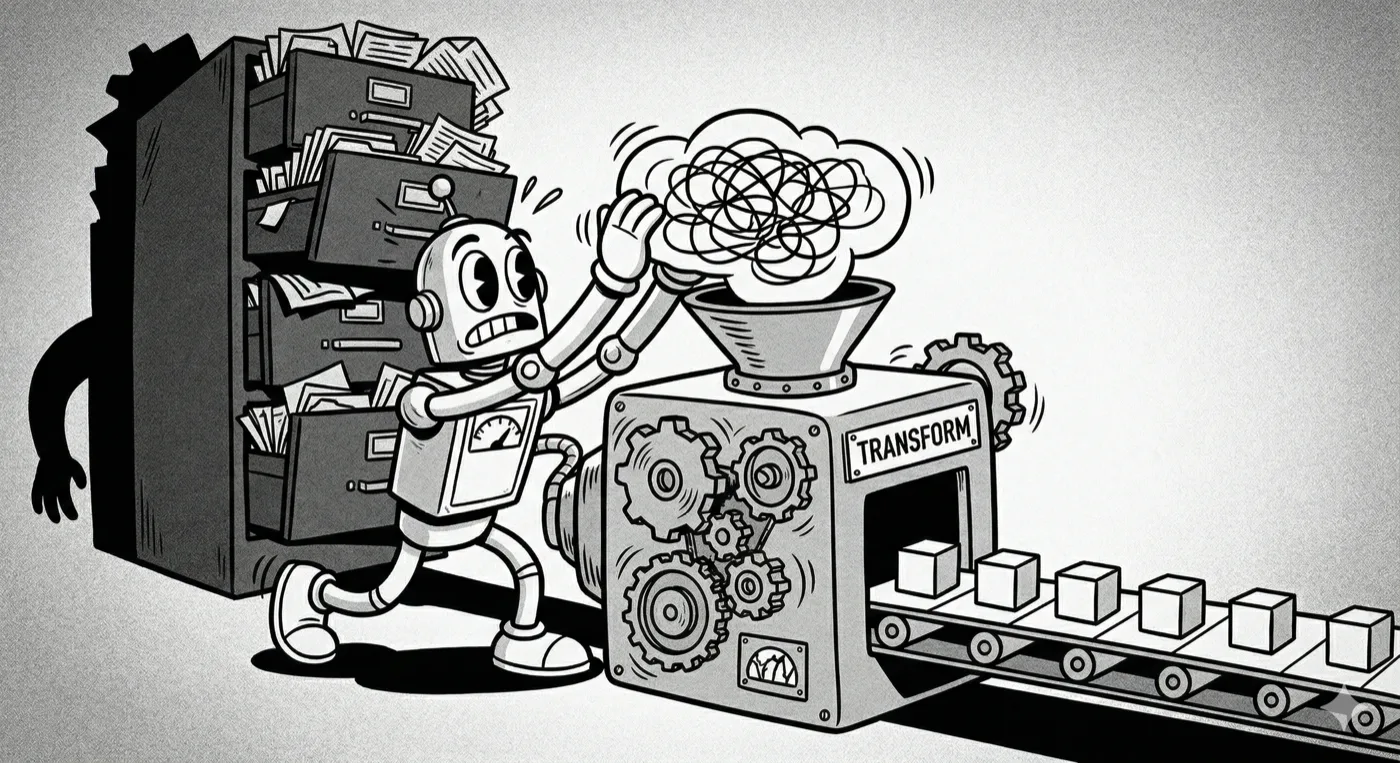
In Section 6, we learned how to optimally quantize a single number. The obvious approach for a vector is: quantize each coordinate independently. But is it optimal?
When Coordinates Are Correlated
In real data, vector coordinates are rarely independent. Consider word embeddings:
Hypothetical pattern in embedding space:
  When coordinate 3 is positive, coordinate 7 tends to be negative.
  When coordinate 3 is negative, coordinate 7 tends to be positive.
Visually, if you plot coordinate 3 vs coordinate 7, instead of a circular cloud (independent), you see an elongated ellipse (correlated):
Independent coordinates:           Correlated coordinates:

  coord 7                            coord 7
    |    . . . .                       |       .  .
    |  . . . . . .                     |     .  .
    |  . . . . . .                     |   .  .
    |  . . . . . .                     |  . .
    |  . . . . . .                     | . .
    |    . . . .                       |. .
    +---------------                   +---------------
         coord 3                            coord 3
When coordinates are correlated, a joint quantizer can exploit this – designing a grid that follows the shape of the data instead of wasting precision on empty corners.
Correlated coordinates mean scalar quantization leaves quality on the table. A joint quantizer that understands the correlation can do better.
Why Full Joint Vector Quantization Fails
You might think: use a lookup table of all possible d-dimensional codewords and find the nearest one. The problem is that to cover d-dimensional space with useful precision at b bits per coordinate, you need a codebook with $2^{b \cdot d}$ entries — a number that grows impossibly fast:
d=128, b=3:   codebook needs 2^384 entries  ← more than atoms in the universe
d=128, b=1:   codebook needs 2^128 entries  ← still impossible
d=8,   b=3:   codebook needs 2^24 = 16M entries  ← marginal but impractical
Even at 1 bit per coordinate, full VQ over 128 dimensions is physically impossible to store or search.
(Clarification: a VQ codebook can have any number of entries K, with log₂(K) bits stored per index. The intractability here is specific to matching scalar quantization’s per-coordinate bit budget — if you want b bits per coordinate, the single shared codebook must index 2^(b·d) distinct codewords. Smaller codebooks are tractable but can’t match the precision of b-bit-per-coordinate scalar quantization.)
Product Quantization: The Practical Compromise
Product Quantization (PQ) is the standard compromise used in vector databases: split the vector into small groups and quantize each group jointly with a small codebook.
128-dim vector, split into 16 groups of 8 dimensions each:

  [x1 x2 ... x8 | x9 x10 ... x16 | ... | x121 ... x128]
   --group 1---   ---group 2----         ---group 16---

Each group: quantized jointly using a learned codebook of 256 entries (8 bits)
PQ captures correlations within each group while ignoring correlations between groups. In benchmarks it works well. But it has a disqualifying flaw for KV cache quantization, which brings us back to Requirement 5 from Section 5: run without preprocessing.
PQ violates Requirement 5. Building the codebook requires k-means clustering on a representative sample of vectors before you can quantize anything:
PQ codebook construction:
  1. Collect a large dataset of vectors from your specific model and domain
  2. Split each vector into groups
  3. Run k-means on each group (256 clusters each)
  4. 37–494 seconds of compute (measured by the TurboQuant paper)
  5. If the distribution shifts (new domain, new model, prompt drift) → repeat
For KV cache quantization, the data you need to compress is generated at runtime, token by token, for prompts you haven’t seen yet. There is no representative sample to cluster on in advance. A codebook trained on technical documentation degrades on legal text; a codebook trained on English degrades on code. And you cannot pause inference to run k-means.
PQ’s offline calibration requirement is the disqualifying problem for KV cache — not codebook size alone. The combinatorial explosion makes full VQ impossible, but PQ’s search over small codebooks is tractable. It’s the prerequisite of needing data you don’t have that rules it out.
The Key Question
We’re stuck between two extremes:
Scalar quantization:  Fast, online, GPU-friendly  (Requirement 5 ✓)
                      But SUBOPTIMAL when coordinates are correlated

Joint quantization:   Optimal (captures all correlations)
                      But IMPOSSIBLE (codebook too large)

Product quantization: Reasonable compromise
                      But OFFLINE (violates Requirement 5 — needs k-means on unseen data)
Here’s the key question TurboQuant answers:
What if you could transform the vector so that its coordinates become independent?
If the coordinates are genuinely independent, then scalar quantization per coordinate is joint quantization. There’s nothing to gain from considering coordinates together because they carry no information about each other.
The reason joint quantization beats scalar quantization is that coordinate correlations let you “borrow” information from one coordinate to quantize another more precisely. If there are no correlations – if knowing coordinate 3 tells you nothing about coordinate 7 – then there’s nothing to borrow. Scalar quantization is already optimal.
Independence: The Formal Idea
Two coordinates $x_i$ and $x_j$ are independent if knowing the value of one gives you no information about the other:
$$P(x_i = a \text{ AND } x_j = b) = P(x_i = a) \times P(x_j = b) \quad \text{for all } a, b$$
If all coordinates are independent and identically distributed, then the optimal vector quantizer is simply the optimal scalar quantizer applied to each coordinate.
This is the theoretical foundation of TurboQuant. The entire algorithm is built to create this condition.
The Roadmap
What we know:
  ✓ Scalar quantization is fast, online, GPU-friendly (Section 6)
  ✓ It's optimal IF coordinates are independent (this section)
  ✓ Lloyd-Max gives the optimal scalar codebook IF you know the distribution (Section 6)

What we need:
  -> A transformation that makes coordinates independent     <- Section 8
  -> A transformation that gives them a KNOWN distribution   <- Section 8
  -> These must work for ANY input vector (worst case)       <- Section 8
It turns out that one single operation – a random rotation – gives us both independence and a known distribution simultaneously. That’s the core insight of TurboQuant.