Transformers — The 10,000 Foot View
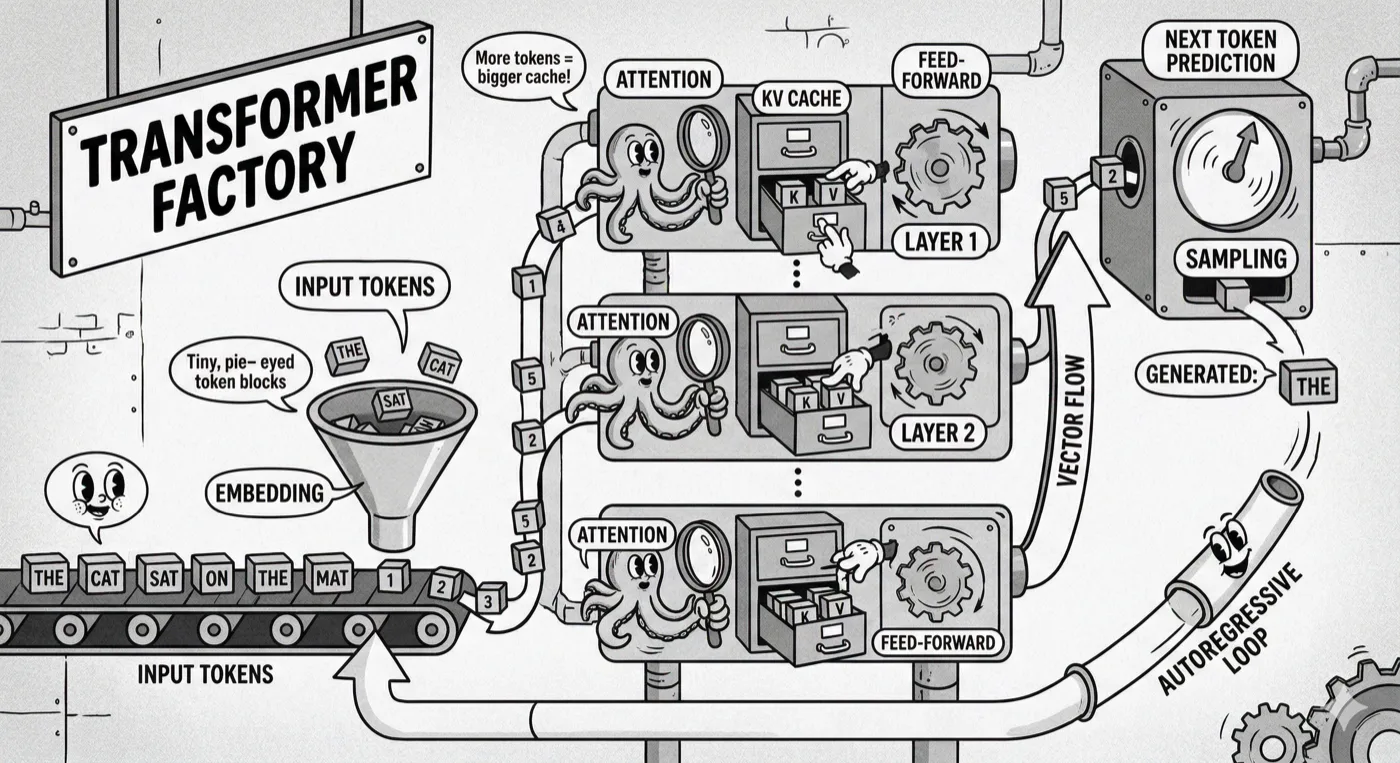
You’ve used ChatGPT, Claude, or Gemini. You type a message, and the model generates a response one word at a time. Let’s look at what’s actually happening under the hood – at the level that matters for understanding the memory problem.
Step 1: Everything Is a Token
LLMs don’t see words – they see tokens.
A token is a chunk of text, roughly a word or a word fragment. The model has a fixed vocabulary of tokens — Llama 3 uses exactly 128K, GPT-4-class models use around 100K, and older models like GPT-2 used 50K. Every input gets split into a sequence of these tokens.
Input:  "The cat sat on the mat"
Tokens: ["The", " cat", " sat", " on", " the", " mat"]
         Token 1  Token 2  Token 3  Token 4  Token 5  Token 6
Some practical rules of thumb:
- 1 token ≈ 4 characters in English
- 1 token ≈ 0.75 words
- A typical page of text ≈ 500 tokens
Why this matters for our story: The KV cache stores one entry per token. More tokens = bigger cache. That’s the linear growth from Section 1.
Step 2: Tokens Become Vectors
Each token gets converted into a vector – a list of numbers that represents the meaning of that token in a high-dimensional space.
"cat" → [0.12, -0.45, 0.78, 0.03, ..., -0.31]   (4096 numbers for Llama 8B)
"dog" → [0.14, -0.42, 0.76, 0.05, ..., -0.28]   (similar to "cat"!)
"tax" → [-0.67, 0.23, -0.11, 0.89, ..., 0.44]   (very different)
The key intuition: similar meanings -> nearby vectors. “Cat” and “dog” are close in this vector space. “Cat” and “tax” are far apart.
This initial conversion is called embedding, and the resulting vector is the token’s starting representation. From here on, everything the model does is manipulating these vectors.
Step 3: The Vector Flows Through Layers
A transformer is a stack of identical processing layers – typically 32 for an 8B model, 80 for a 70B model.
Token embedding (4096-dim vector)
        |
        v
  +---------------+
  |   Layer 1     |  <- Each layer refines the vector's meaning
  +-------+-------+
          v
  +---------------+
  |   Layer 2     |
  +-------+-------+
          v
         ...
          v
  +---------------+
  |   Layer 32    |
  +-------+-------+
          v
  Final vector -> Next token prediction
Each layer does two things:
Attention: “Look at all the previous tokens and figure out which ones are relevant to me right now.” (This is where the KV cache lives – we’ll go deep in the next section.)
Feed-forward network: “Now think about what I’ve gathered and update my representation.” (This is a standard neural network – no caching involved.)
The vector goes in, gets refined, comes out. Then into the next layer, gets refined again. By the end, the vector has been enriched with contextual understanding from all previous tokens across all layers.
Step 4: Generation Is One Token at a Time
Here’s the crucial part: the model generates text one token at a time.
Step 1: Input "The cat"        -> Model predicts " sat"
Step 2: Input "The cat sat"    -> Model predicts " on"
Step 3: Input "The cat sat on" -> Model predicts " the"
...
At each step, the model:
- Takes all the tokens so far
- Runs them through all 32 layers
- Produces a probability distribution over the next token
- Picks one (sampling)
- Appends it and repeats
This is called autoregressive generation – each new token depends on all previous tokens.
The efficiency problem: At step 100, the model needs to process all 100 tokens through all 32 layers. At step 1000, all 1000 tokens. Recomputing everything from scratch at each step would be disastrously slow.
This is why the KV cache exists – to avoid recomputing past tokens. Instead of rerunning the entire sequence through every layer, you cache the intermediate results (Keys and Values) and only compute the new token’s contribution.
The Mental Model You Need
Here’s the simplified picture to carry forward:
+----------------------------------------------------+
|                  TRANSFORMER                        |
|                                                     |
|  Tokens -> Vectors -> [Layer 1] -> [Layer 2] -> ... |
|                          |           |              |
|                       KV Cache    KV Cache          |
|                      (Layer 1)   (Layer 2)          |
|                                                     |
|  ... -> [Layer 32] -> Final Vector -> Next Token    |
|            |                                        |
|         KV Cache                                    |
|        (Layer 32)                                   |
+----------------------------------------------------+
Every layer has its own KV cache. Every token adds to every layer’s cache. That’s the multiplicative effect from Section 1.
You don’t need to understand backpropagation, gradient descent, or training to follow the rest of this presentation. You just need:
- Tokens are the units of text
- Vectors are how the model represents them (lists of numbers)
- Layers process vectors sequentially, each one refining the representation
- Attention (inside each layer) is how one token “looks at” previous tokens
- The KV cache stores past tokens’ intermediate results to avoid recomputation
- Generation is autoregressive – one token at a time, each depending on all previous ones
Next up: zooming into the attention mechanism – the one component that makes the KV cache necessary, and the one whose accuracy TurboQuant must preserve.