The Memory Wall — Why You Should Care
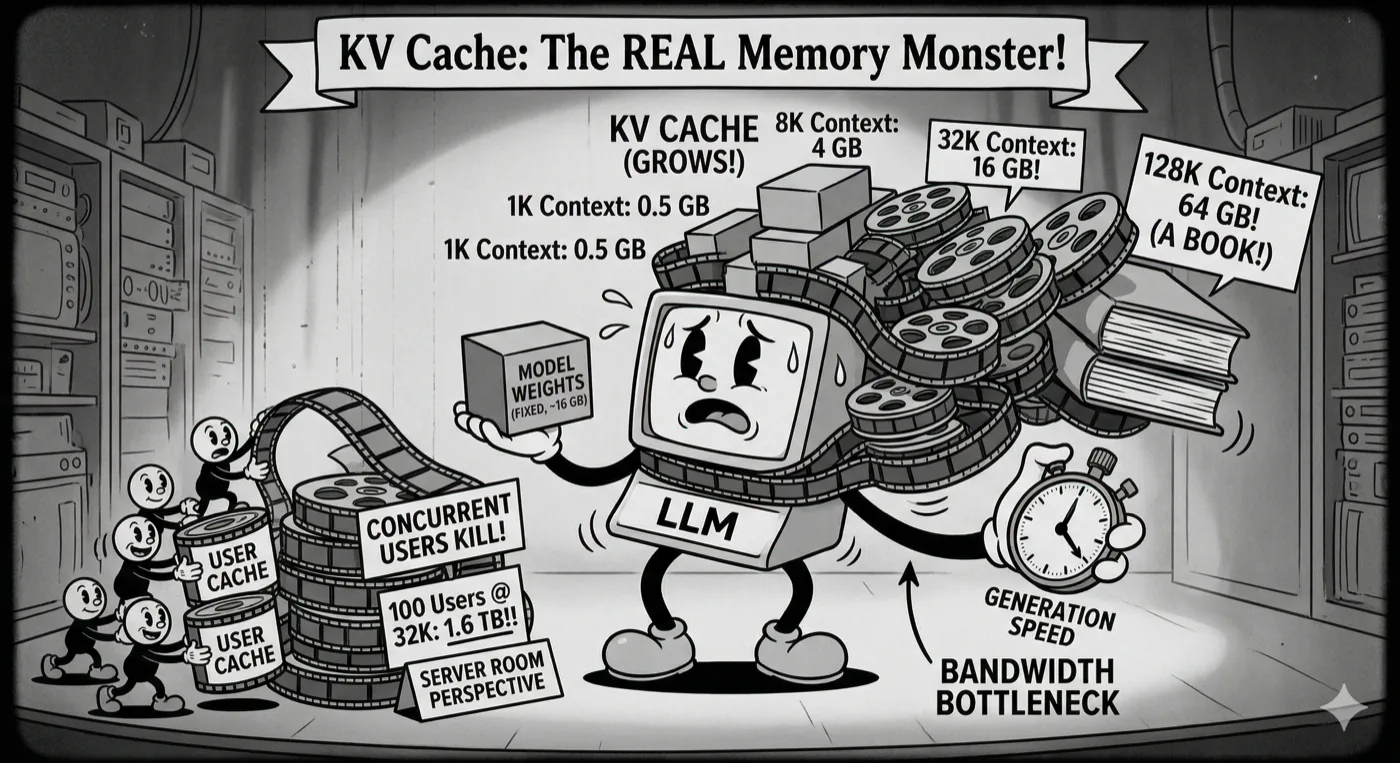
Running Llama 3.1 8B with 512 concurrent users at 32K context requires roughly 2 TB of memory – just for the KV cache. At 80 GB per H100, that’s the memory capacity of 25+ GPUs consumed by one model’s conversation history. This section explains exactly where that memory goes, and how a paper from Google Research makes most of it disappear – without losing a single correct answer.
The Cost Nobody Talks About
When people think about the memory cost of running an LLM, they think about the model weights – the billions of parameters that define the model. And yes, those are big:
| Model | Parameters | Weight Memory (FP16) |
|---|---|---|
| Llama 3.1 8B | 8 billion | ~16 GB |
| Llama 3.1 70B | 70 billion | ~140 GB |
| GPT-4 class | ~1.8 trillion (rumored) | ~3.6 TB |
But here’s the thing most engineers don’t realize: the model weights are fixed. You load them once. They don’t grow. The thing that grows – the thing that will actually crash your GPU – is something called the KV cache.
What Is the KV Cache?
Every time an LLM processes or generates a token, it stores a “memory” of that token so it doesn’t have to reprocess the entire conversation from scratch. That stored memory is the KV cache.
We’ll explain how this works in detail in the next section. For now, just understand this:
The KV cache grows linearly with the number of tokens in the conversation.
Every new token adds a fixed amount of memory. And it adds that memory at every layer of the model, and at every attention head within each layer.
The Brutal Math
Let’s do the math for Llama 3.1 8B. Modern LLMs use two different attention variants, and the KV cache size differs substantially between them.
Simplified MHA (Multi-Head Attention) — for illustration:
KV cache per token = 2 (key + value)
                   × 32 (layers)
                   × 32 (attention heads)  ← full MHA
                   × 128 (dimension per head)
                   × 2 bytes (float16)
                   = 524,288 bytes ≈ 0.5 MB per token
Actual Llama 3.1 8B uses GQA (Grouped Query Attention) — 8 KV heads, not 32:
KV cache per token = 2 (key + value)
                   × 32 (layers)
                   × 8 (KV heads, shared across 4 query groups)
                   × 128 (dimension per head)
                   × 2 bytes (float16)
                   = 131,072 bytes ≈ 0.125 MB per token
GQA reduces the KV cache 4x versus MHA. But even at 0.125 MB per token, scale tells the rest of the story:
| Context Length | MHA (simplified) | GQA (actual Llama 3.1) | What This Means |
|---|---|---|---|
| 1K tokens | ~0.5 GB | ~0.125 GB | A short chat |
| 8K tokens | ~4 GB | ~1 GB | A long conversation – tight on a consumer GPU |
| 32K tokens | ~16 GB | ~4 GB | A document – equals the model weights |
| 128K tokens | ~64 GB | ~16 GB | A book – fills one H100 just for the cache |
Key Insight: Even with GQA’s 4x reduction, at 128K context the KV cache still equals the entire model. And that’s for one user. GQA reduced the constant; it didn’t change the linear growth.
The Server Room Perspective
Now think about this from a production serving perspective (GQA — actual Llama 3.1 8B numbers):
| Scenario | KV Cache Memory |
|---|---|
| 1 user, 32K context | ~4 GB |
| 10 concurrent users, 32K each | ~40 GB |
| 100 concurrent users, 32K each | ~400 GB |
| 512 concurrent users, 32K each | ~2 TB |
An H100 GPU has 80 GB of HBM. With 100 concurrent GQA-equipped users at 32K context, you need 5 H100s just for the KV cache, before loading a single model weight. The 4x GQA win disappears quickly once user count climbs.
This is why:
- Your local LLM chokes on long documents. The context window exists but the memory doesn’t.
- Cloud inference is expensive. You’re paying for GPUs that are mostly storing cached past tokens, not doing useful computation.
- “Just add more context” isn’t free. Every doubling of context length doubles the KV cache, which means doubling the GPU memory.
- Concurrent users are the real killer. Each user gets their own KV cache. Scaling users scales memory linearly.
The Bandwidth Problem
It’s not just about fitting in memory. Even when the KV cache does fit, it creates a bandwidth bottleneck.
During token generation, for every single new token, the model must:
- Read the entire KV cache from GPU HBM (high-bandwidth memory)
- Compute attention scores against all cached tokens
- Write the new token’s key and value back to the cache
The relevant metric here is arithmetic intensity — the ratio of compute operations to bytes of memory accessed. At short contexts, the FFN layers dominate and arithmetic intensity is high (compute-bound: the GPU is working hard). As context grows, the KV cache read dominates and arithmetic intensity drops sharply (memory-bound: the GPU is waiting for data, not computing).
HBM bandwidth — the ceiling on memory-bound throughput:
  H100 SXM:  3.35 TB/s
  H200 SXM:  4.80 TB/s  (+43% vs H100)
  B200 SXM:  8.00 TB/s  (+139% vs H100)

At 32K context with Llama 8B GQA, KV data per decode step:
  FP16 KV:          4.0 GB  →  ~1.2 ms read time on H100  (4.0 GB ÷ 3.35 TB/s)
  TurboQuant 4-bit: 1.0 GB  →  ~0.3 ms read time on H100  (4× less data to move)
TurboQuant doesn’t change the bandwidth ceiling — that’s determined by the GPU. What it does is reduce how much data must cross that ceiling every step. At memory-bound context lengths, this translates directly to faster generation.
Smaller KV cache = less data to cross the HBM bandwidth ceiling each step = faster decode.
H200 and Beyond: Bigger HBM Doesn’t End the Problem
NVIDIA’s H200 has 141 GB of HBM3e and 4.8 TB/s bandwidth; the B200 has 192 GB and 8.0 TB/s. That’s more capacity and more bandwidth. Does that make the KV cache problem go away?
No. It shifts the constraint on two dimensions simultaneously:
Memory capacity comparison (Llama 3.1 8B, 32K context per user, GQA):
  H100 (80 GB):   ~5 users before KV cache fills the GPU
  H200 (141 GB):  ~11 users
  B200 (192 GB):  ~15 users

With TurboQuant (4× KV compression):
  H100:           ~20 users
  H200:           ~44 users
  B200:           ~60 users
More HBM raises the memory ceiling. More bandwidth raises the throughput ceiling. But model ambitions are raising both simultaneously: Llama 4 Scout supports 10M-token context. At 1M tokens, even a B200 fills up with a single user at full precision.
The rack-scale picture is worth noting: The GB200 NVL72 — the system unit actually deployed at cloud scale — combines 72 B200 GPUs with 13.5 TB aggregate HBM and 14.4 TB/s NVSwitch fabric. At 13.5 TB, uncompressed KV capacity jumps dramatically. But so does the model size: frontier models that fill a 72-GPU rack at FP16 weights still fill the KV cache at long contexts and high concurrency. TurboQuant’s multiplier applies equally to the NVL72’s 13.5 TB as to a single GPU’s 192 GB.
Bigger HBM raises the ceiling, but model ambitions raise it faster. TurboQuant’s multiplier compounds with every hardware generation rather than competing with it.
The Punchline
So we have a problem:
- The KV cache is often larger than the model itself
- It grows linearly with context length and number of users
- It creates a bandwidth bottleneck that slows down generation
- And it can’t be compressed with traditional methods because it’s generated on the fly – you can’t preprocess it
What if you could compress every vector in the KV cache from 16 bits per coordinate down to 3-4 bits – a 4-5x reduction – with near-zero loss in model quality (and zero measurable loss on standard long-context benchmarks at 3.5 bits)?
That’s TurboQuant.
And the beautiful part: it does this using just three operations – a rotation, a table lookup, and a 1-bit error correction – all backed by a mathematical proof that you can’t do much better.
Let’s understand how.